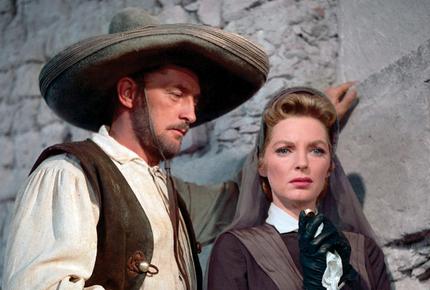
On Leave Her to Heaven (John M. Stahl,1945)
(Published originally in Spanish in Butaca Ancha http://butacaancha.com/leave-her-to-heaven-john-m-stahl/on December 2nd, 2021)
Richard: And what made you change your mind?
Ellen: I got interested in one of the characters
Richard: Which one?
Ellen: The author
-Dialogue between Ellen Berent and Richard Harland
in Leave Her to Heaven (John M. Stahl, 1945)
How would the biographical note in the back cover of a book written by Ellen Berent, the protagonist of John M. Stahl’s Leave Her to Heaven, be? About the portrait there isn’t much to say: any picture of her may show her guileless perversity. It is more interesting to speculate about the words that would try, in vain, to summarize her life. Biographical notes, when written from the inherent distance from the third person, are made of short sentences that work as some sort of epithets. The core of those epithets is a word that encompasses the ways in which the person relates to others, their profession and social rank, along with the activities they usually do. In Ellen Berent’s case, according to her actions in the film, we could think about these ones: “reader”, “daughter”, “fiancée”, “horse rider”, “swimmer”, “orphan”, “wife”, “mother”, “chess player”, “cousin”, “murderer”, or “suicide”. Nevertheless, it is impossible to contain a person’s biography within a few words.
As evidence, we may take, for instance, a biographical note that is shown emphatically and colorfully in Stahl’s film: that of Richard Harland’s book Time without End, which Ellen herself reads in the sequence where she is introduced. She holds it firmly. (By the way, in Leave Her to Heaven, books are a recurrent object; their materiality is registered with attentive devotion). The back cover hides Ellen’s face—therefore, her entrance to the frame comes from behind a book—and it has a little paragraph, accompanied by a portrait of her future fiancé. The photograph shows the man’s prudish face that fascinates the people around him. Later in the film, the biographical note is a key. Ellen memorizes and recites it to Richard: he is in his thirties, single, Bostonian, a Harvard graduate, painter, journalist, and trilingual. The text, for instance, doesn’t say anything about Danny, Harland’s sick little brother. And is it not the teenager with a disability the most important part of Richard’s life? Do Richard’s life decisions not revolve around him, because of his demanding loving care? There is the second evidence that biographical notes tend to leave out the life’s most essential parts. In the end, they contribute to the creation of a character: in this case, the character of Richard Harland as author.
Let us go back to the question in the beginning of this text, the one that suggested the possibility of exploring, though not exhaustively, the character of Ellen Berent as an author too, by imagining her biographical note. This speculative exercise can unveil invisible truths about her. The two words I choose for this matter are “reader” and “chess player”. The first one is quite evident from the presentation of the character in the movie I described above. The second one is strictly metaphorical: sometimes metaphors are the vest vehicle for finding truth. Ellen reads. She reads in a train; then, she does it again on the wood balcony in Back of the Moon. She performs this activity with an astonishing insight. As the great reader she is, Ellen has a flawless memory, which is demonstrated when she learns long fragments to recite by heart; or when she easily finds quotes in the books she reads. Ellen has an attentive ear provided by her close reading. These tools intervene in her life path, beyond her taste for literature. For example, when Russel Quinton, her former fiancé, tells her not to forget that he will always love her, Ellen indeed doesn’t forget it. After a while, she remembers these words and writes him a letter, in a revengeful way out of her oppressive situation. Ellen also writes. Reading, in addition, provides her with a talent for speaking in public. As a prove of that, it is enough to see the grace with which she narrates her premonitory dream, as if it were a lyrical horror tale. Her characterization as reader is materialized in her relationship with space and in the mise-en-scène: the library in the New Mexico’s house is Ellen’s confessionary place, where, if anyone that is not her enters, it is because she has invited him.
Regarding the mise-en-scène, in that house’s living room, where Ellen and Richard have turkey sandwiches for supper, there are some chessboards on the décor’s furniture. Although we never see a game, their presence is suggestive enough to say that Ellen Berent is a chess player, because she goes through life with such mentality, to the point where she metaphorically fuses with the pieces themselves. She is always several movements ahead of the people that surround her. She anticipates and coolly calculates her rival’s play—which, in the film, are the rest of the characters, as they constantly mention. Ellen moves in the chess board—the frame, that is—as if she were the Queen (the White one, of course, because she opens every match): diagonally, forward, backward, she enters and exits, by land and by water, chasing the opponent’ pieces. In chess, the only forbidden move for the Queen is the Knight’s “L-shape”, the protagonist of Stahl’s film symbolically appropriates that move in the graceful sequence where she rides through the dessert, spreading her father’s ashes. The film’s ending is nothing else than a Queen’s sacrifice for winning the game. It is worth to remember that checkmate in chess isn’t a violent murder; instead, it is a reign of space, which leaves the opponent King with no possibility of movement, just like the speechless Richard Harland in that gloomy courthouse toward the film’s ending.
The Shakespearean title suggests some sort of hope for Ellen: that of being judged by a more transcendental entity, rather than by her peers, who define the woman in alien terms for her. However, isn’t she truly “left to heaven” in Stahl’s film itself? That is to say, the title is not a fable of Ellen’s possible redemption for her sins on Earth in front of a Supreme Being. It is, instead, a fact: heaven judges her in every frame where the blue sky, the sunlight, and the limpid clouds are shown behind the woman. In those few moments of pure freedom in Warms Springs and Back of the Moon, Ellen shines bright.

 The Wonderful Country
Deja un comentario